Partnerships for the Goals
Strengthen the means of implementation and revitalise the global partnership for sustainable development
Collaboration with NGOs for SDGs
Student Volunteering Programmes in Collaboration with NGOs
Vinayaka Mission’s Research Foundation (Deemed to be University) promotes student volunteering through collaborative initiatives with non-governmental organisations, voluntary organisations, community groups and public-service institutions. Through its National Service Scheme (NSS), Youth Red Cross (YRC) and Red Ribbon Club (RRC), the University provides students with opportunities to participate in community-oriented programmes that address public health, social awareness, environmental responsibility and community well-being.
These collaborative programmes enable students to work alongside external organisations, understand local community needs and contribute their knowledge, time and skills to meaningful social initiatives. Students participate in awareness rallies, street plays, public education campaigns and community service activities, thereby developing leadership, teamwork, communication skills and a sense of social responsibility.
Major Collaborative Student Volunteering Initiatives
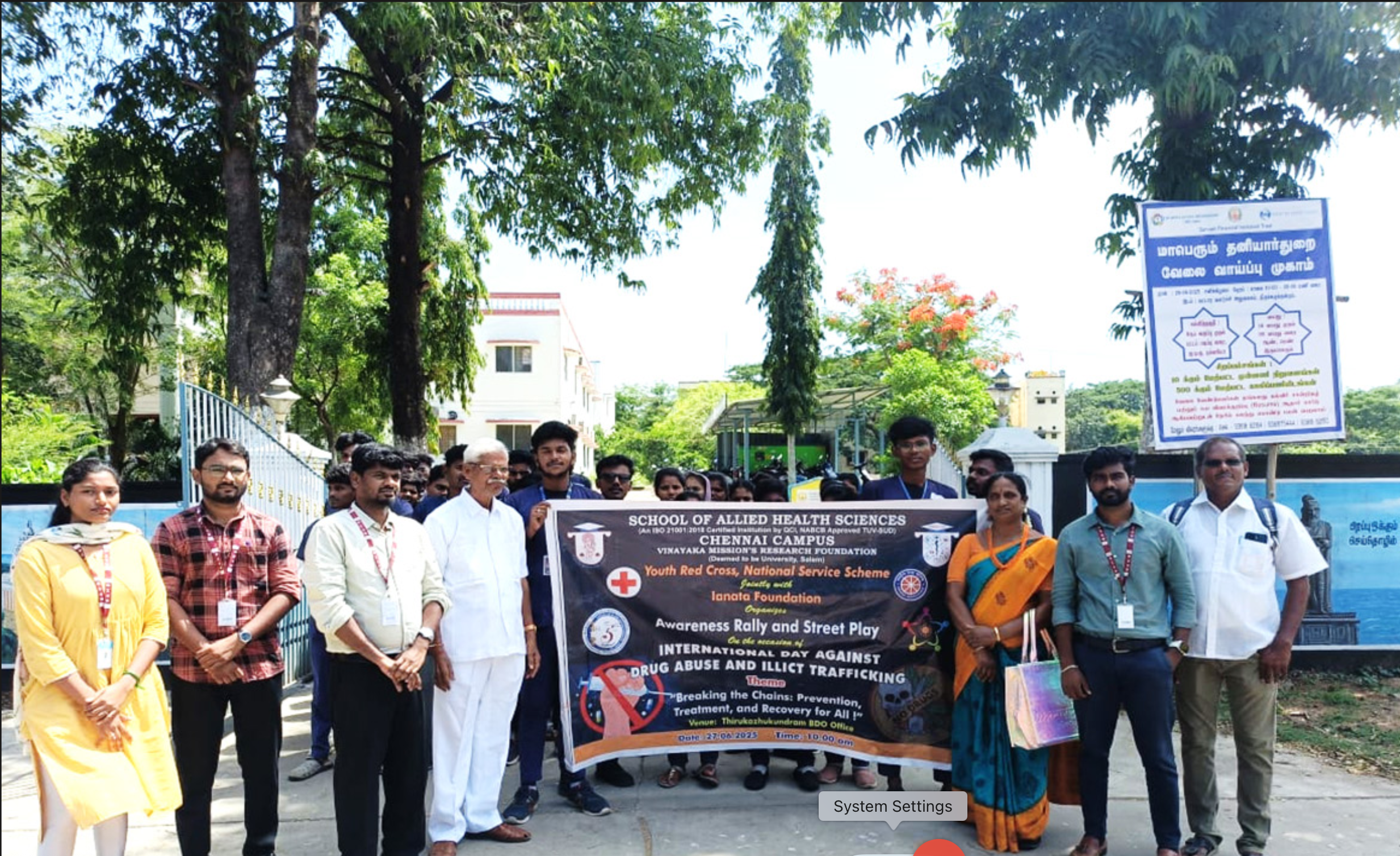
1. Anti-Drug Awareness Rally and Street Play with IANATA Foundation – June 2025
The Youth Red Cross and NSS Units of the School of Allied Health Sciences, VMRF (DU), collaborated with the IANATA Foundation to organise an awareness rally and street play on the occasion of the International Day Against Drug Abuse and Illicit Trafficking in June 2025. Student volunteers participated in public-awareness activities highlighting the harmful effects of drug abuse and the importance of prevention. The initiative provided students with an opportunity to engage directly with the public through awareness communication and community participation.
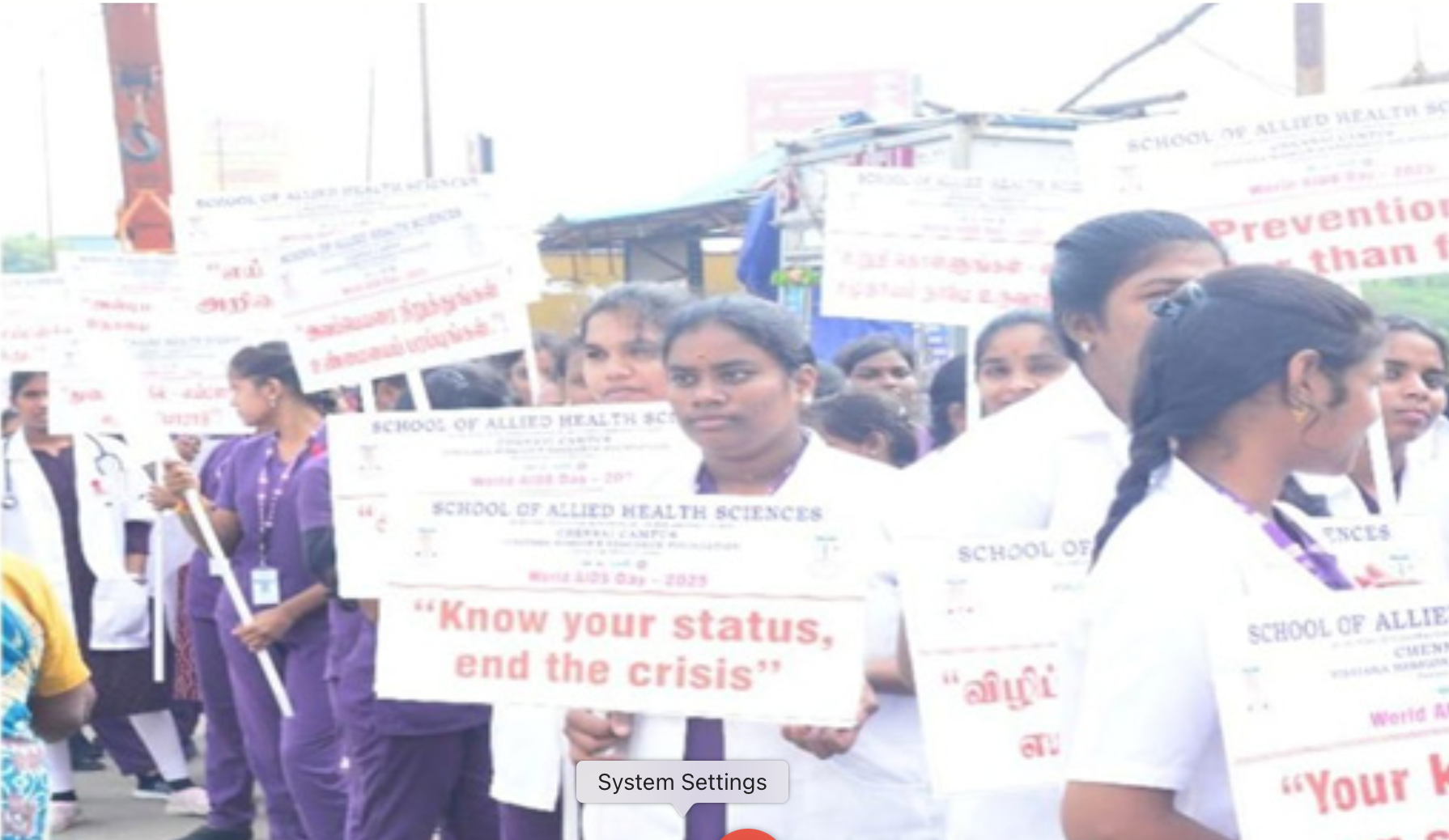
2. World AIDS Day Awareness Rally with Tamil Nadu AIDS Control Society and Indian Red Cross Society – December 2025
On 9 December 2025, the Youth Red Cross and NSS of the School of Allied Health Sciences, Chennai Campus, in collaboration with the Tamil Nadu AIDS Control Society and the Indian Red Cross Society, Chengalpattu District, organised a World AIDS Day awareness rally. Approximately 200 students participated by carrying awareness placards and posters and communicating messages on HIV/AIDS prevention and awareness. The programme encouraged public engagement, responsible attitudes and the reduction of stigma associated with HIV/AIDS.
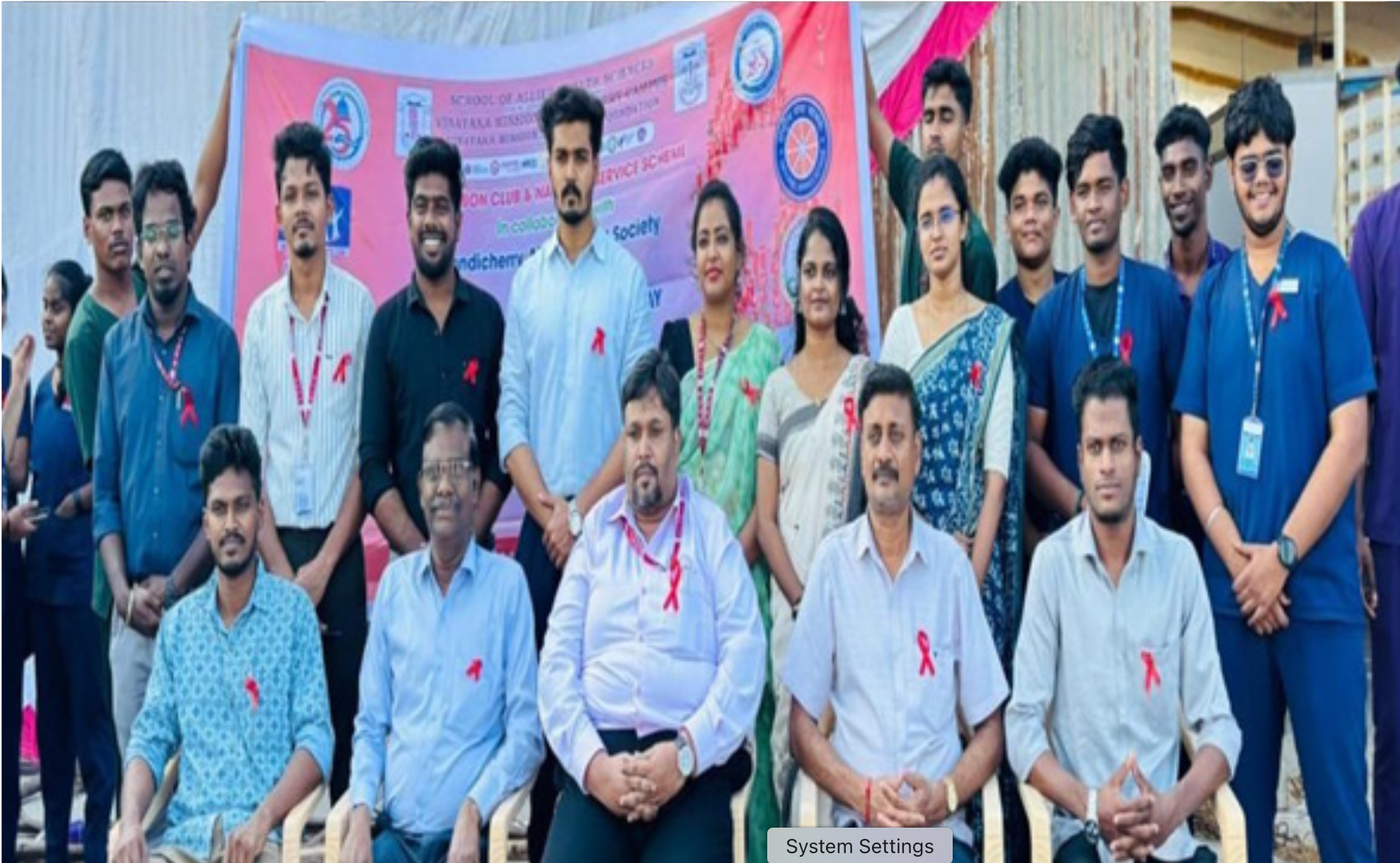
3. World AIDS Day Rally and Street Play with Pondicherry AIDS Control Society – December 2025
The Red Ribbon Club and National Service Scheme of VMRF (DU), in collaboration with the Pondicherry AIDS Control Society, organised a World AIDS Day awareness rally and street play at Rock Beach on 18 December 2025. Student volunteers actively participated in the rally by displaying placards and communicating messages on HIV prevention and social responsibility. The street play further engaged the public by addressing HIV transmission, preventive practices and stigma, demonstrating the role of student volunteers in community health education.
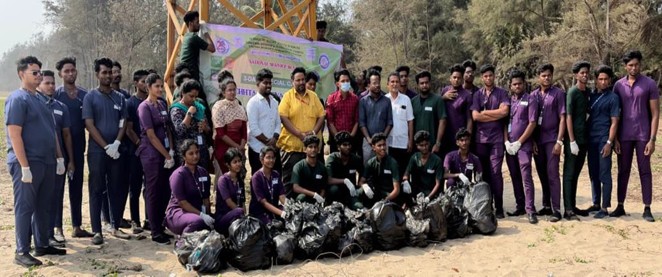
4. Beach Clean-up Initiative with Puducherry Coastal Movement – September 2025
NSS volunteers from VMRF (DU) joined hands with the Puducherry Coastal Movement for a beach clean-up initiative in Karaikal on 26 September 2025. The activity encouraged students to contribute to environmental cleanliness, responsible waste management and community participation. Through this collaborative effort, student volunteers gained practical experience in environmental service and collective action for sustainable communities.
Institutional Approach to NGO Collaboration
VMRF (DU) encourages active collaboration between student service units and external organisations to extend the reach and effectiveness of community engagement programmes. The University facilitates student participation in initiatives that address locally relevant social, health and environmental challenges. Such partnerships provide a platform for students to contribute to community development while learning from the experience and expertise of partner organisations.
Contribution to the Sustainable Development Goals
The University's collaborative student volunteering programmes support the following Sustainable Development Goals:
- SDG 3 – Good Health and Well-being: HIV/AIDS awareness, drug-abuse prevention and public health education.
- SDG 4 – Quality Education: Experiential learning, public communication and development of social responsibility among students.
- SDG 11 – Sustainable Cities and Communities: Community participation and environmental cleanliness initiatives.
- SDG 13 – Climate Action: Environmental awareness and responsible community practices.
- SDG 17 – Partnerships for the Goals: Collaboration with voluntary organisations, foundations, community groups and public-service institutions.
Commitment to Community Service
VMRF (DU) remains committed to strengthening student volunteering through meaningful partnerships with NGOs and other external organisations. By encouraging students to participate in collaborative outreach and awareness initiatives, the University seeks to nurture socially responsible graduates who actively contribute to public well-being, inclusive development and sustainable communities.
Collaborative Research Programmes
Overview
Vinayaka Mission’s Research Foundation (Deemed to be University) promotes collaborative research with external academic and research institutions to address significant societal, scientific, environmental and sustainable development challenges. Through these partnerships, the University encourages knowledge exchange, joint scholarly activities, interdisciplinary research and the development of solutions that contribute to the Sustainable Development Goals (SDGs).
During 2025, VMRF (DU) collaborated with a broad network of academic and research institutions across India and other countries.
Research Collaboration – 2025 at a Glance
|
Indicator |
Number |
|
Total external collaborating institutions |
433 |
|
Academic research collaborators (NGO/non-governmental academic partner) |
387 |
|
Medical institutions |
22 |
|
Government institutions |
14 |
|
Corporate institutions |
8 |
|
Other institutions |
2 |
|
Total co-authored research publications |
678 |
|
Countries represented by collaborating institutions |
56 |
Regional Distribution of Research Collaborations
VMRF (DU)’s research collaborations extend across several geographical regions, demonstrating its engagement with national and international academic and research networks.
|
Region |
Collaborating institutions |
Co-authored publications |
|
Asia Pacific |
311 |
665 |
|
Middle East |
47 |
70 |
|
Europe |
28 |
25 |
|
Africa |
24 |
16 |
|
North America |
20 |
21 |
|
South America |
3 |
6 |
|
Worldwide total |
433 |
678 |
Major Academic Research Collaborators
The following academic institutions are among VMRF (DU)’s leading collaborators based on the number of co-authored publications recorded in the Scopus dataset for 2025.
|
Academic research partner |
Co-authored publications |
|
Chitkara University |
129 |
|
Saveetha Institute of Medical and Technical Sciences |
124 |
|
Noida International University |
119 |
|
Siksha ‘O’ Anusandhan University |
75 |
|
Vel Tech University |
62 |
|
SRM Institute of Science and Technology |
58 |
|
Sathyabama Institute of Science and Technology |
55 |
|
JAIN (Deemed-to-be University) |
51 |
|
Parul University |
50 |
|
Sri Balaji Vidyapeeth University |
27 |
Collaborative Research and Sustainable Development
VMRF (DU) recognises collaborative research as an important mechanism for addressing complex development challenges. Through partnerships with academic and research institutions, the University facilitates the exchange of research expertise, access to specialised knowledge, interdisciplinary approaches and the dissemination of scholarly findings.
These collaborations provide opportunities to contribute to areas aligned with the Sustainable Development Goals, including:
- SDG 3 – Good Health and Well-being: Research collaboration in healthcare, medical sciences, public health and health-related innovation.
- SDG 4 – Quality Education: Academic knowledge exchange, research training and collaborative scholarly development.
- SDG 9 – Industry, Innovation and Infrastructure: Research, technological development and innovation through institutional partnerships.
- SDG 10 – Reduced Inequalities: Research addressing social challenges and disparities.
- SDG 13 – Climate Action: Opportunities for collaborative research on environmental sustainability and climate-related challenges.
- SDG 17 – Partnerships for the Goals: Strengthening institutional networks and collaborative research relationships across national and international boundaries.
Digital Learning Resources for Accessible and Inclusive Education
Vinayaka Mission’s Research Foundation (Deemed to be University) (VMRF (DU)) promotes accessible and technology-enabled education through the dissemination of educational videos on its official YouTube platform. These digital learning resources provide students, faculty members, researchers and the wider community with opportunities to access academic content beyond the conventional classroom environment.
The University makes these video resources available online, supporting flexible learning, independent study, knowledge sharing and the wider dissemination of academic information. The collection includes subject-specific lectures, demonstrations, clinical and dental science topics, research methodology, healthcare awareness and other educational materials contributed by faculty members and students.
Open Access and Digital Learning
By making educational videos available through its YouTube platform, VMRF (DU) supports wider access to academic learning resources. Students can revisit subject content, strengthen their understanding of important concepts and use the videos as supplementary learning material. Faculty members and learners can also access relevant resources beyond scheduled classroom sessions.
The online availability of these resources contributes to flexible learning and the dissemination of educational knowledge to a wider audience, including learners who may not be physically present on campus.
Contribution to Sustainable Development Goal 4 – Quality Education
VMRF (DU)'s open-access educational video initiative supports SDG 4 – Quality Education, particularly through the use of digital learning resources to promote inclusive and equitable access to knowledge.
The initiative contributes to:
- Accessible learning resources: Making educational content available online for students and other interested learners.
- Flexible learning opportunities: Enabling learners to access and revisit academic videos at their convenience.
- Quality academic content: Supporting subject-based learning through faculty contributions and educational demonstrations.
- Digital education: Encouraging the use of online platforms for knowledge dissemination and supplementary learning.
- Knowledge sharing: Providing a platform for academic presentations, student contributions and educational awareness.
Institutional Commitment
VMRF (DU) continues to strengthen its digital learning initiatives by encouraging the development and dissemination of educational video resources. Through its YouTube platform, the University supports accessible learning, academic engagement and knowledge sharing across different subject areas.
The University remains committed to leveraging digital platforms to complement classroom teaching, extend learning opportunities and contribute to the advancement of quality education.
List of Online Videos available for educational resources for SDG 3
|
S.No |
Title |
Link |
|
1. |
Pit And Fissure Sealants |
|
|
2. |
Working Length Determination | |
|
3. |
National Health Policy 2017 | |
|
4. |
Adult Orthodontics | |
|
5. |
Principles of Tooth Preparation | |
|
6. |
Defense Mechanism of The Gingiva | |
|
7. |
Radiographic Intensifying Screen | |
|
8. |
Disease Etiology | |
|
9. |
Bacterial Infections of The Oral Cav |
|
|
10. |
Cephalometrics Analysis |
|
|
11. |
Esthetic Crowns |
|
|
12. |
Distraction Osteogenesis |
|
|
13. |
Hot Tooth Pain Pathway | |
|
14. |
Oral Submucous Fibrosis | |
|
15. |
Resective Osseous Surgery | |
|
16. |
Immediate Complete Dentures | |
|
17. |
Pulpectomy | |
|
18. |
Radiation Physics | |
|
19. |
Odontogenic Tumors | |
|
20. |
Periodontal Diseases | |
|
21. |
Epidemiology of Malocclusion | |
|
22. |
Gypsum Products | |
|
23. |
Furcation & its Management | |
|
24. |
Extra Oral Radiology | |
|
25. |
Root Canal Irrigants | |
|
26. |
Apicoectomy | |
|
27. |
Biology Of Tooth Movement | |
|
28. |
Influence of Stress on Periodontium | |
|
29. |
Mechanical Plaque Control | |
|
30. |
Special Impression Procedures | |
|
31. |
The Role of Endodontics After Dental | |
|
32. |
Maxillary Nerve Blocks | |
|
33. |
Mandibular Fractures | |
|
34. |
Oral Lichen Planus | |
|
35. |
Molar Incisor Hypomineralization |
|
|
36. |
Basics of Research Methodology | |
|
37. |
Interceptive Orthodontics | |
|
38. |
Mechanical Plaque Control | |
|
39. |
Impacted Third Molar Surgery And Its Comp |
|
|
40. |
Tooth Numbering System | |
|
41. |
Anticipatory Guidance In Pediatrics | |
|
42. |
Success Vs Failure In Endodontic | |
|
43. |
Basics In Dental Implants | |
|
44. |
Health Promotion | |
|
45. |
Diseases of Nerves and Muscle | |
|
46. |
Host Modulation | |
|
47. |
Digital Imaging | |
|
48. |
Fixed Space Maintainers | |
|
49. |
Soldering And Welding In | |
|
50. |
Apthous |
https://www.youtube.com/watch?v=kxMvHv_phKc |
|
51. |
Temporomandibular Joint Ankylosis | |
|
52. |
Connectors In Fixed Partial Dentures | |
|
53. |
Clinical Features of Gingivitis | |
|
54. |
Apthous | |
|
55. |
Role of Diet In Dental Caries | |
|
56. |
Steps In Fabrication of Complete Denture | |
|
57. |
Calcium Hydroxide in Endodontics | |
|
58. |
Maxillary Nerve Block | |
|
59. |
Child Psychology | |
|
60. |
Oro Facial Pain | |
|
61. |
Extractions | |
|
62. |
Aggressive Periodontitis | |
|
63. |
VMS Dental College | |
|
64. |
Abutment Tooth Selection In FPD | |
|
65. |
Eruption of Teeth | |
|
66. |
Condylar Fractures | |
|
67. |
Management of Class III Malocclusion | |
|
68. |
Finance In Dental Care | |
|
69. |
Magnetic Resonance Imaging | |
|
70. |
Vital Pulp Therapy – Indirect Pulp Cap | |
|
71. |
Structure of Enamel | |
|
72. |
Periodontal Pocket | |
|
73. |
Air Abrasion |
|
|
74. |
Stainless Steel Crown |
|
|
75. |
Frenectomy |
|
|
76. |
Osseo Integration |
|
|
77. |
Mouth Preparation In Removable |
|
|
78. |
Maxillary Sinus |
|
|
79. |
Research Methodology |
|
|
80. |
Preventive Orthodontics |
|
|
81. |
Bell’s Palsy and its Management |
|
|
82. |
Malignant |
|
|
83. |
Resin Dentin Interface |
|
|
84. |
Veneers Part 1 |
|
|
85. |
Radiation Safety And Protection |
|
|
86. |
Pediatric Exodontia | |
|
87. |
Mechanical Plaque Control | |
|
88. |
Interceptive Orthodontics | |
|
89. |
Clinical Trial | |
|
90. |
White Lesions Of The Oral Cavity |
|
|
91. |
Elastomeric Impression Materia |
|
|
92. |
Endocrown |
|
|
93. |
Oral Manifestations Of Dermatological Diseases | |
|
94. |
Silver Diamine Fluoride | |
|
95. |
Anchorage | |
|
96. |
Management Of Orbital Floor Fractures | |
|
97. |
Non Surgical Endodontic treatment |
https://www.youtube.com/watch?v=4j2I9ToxXHc&t=13s
|
|
98. |
Radiation Physics | https://www.youtube.com/watch?v=ZGcjfjpgY08 |
|
99. |
Defense Mechanism in Gingiva 1 | https://www.youtube.com/watch?v=FGSp52t0P6I |
|
100. |
Failures In Fixed Partial Dentures | https://www.youtube.com/watch?v=0p7ppKeM7po |